 comparison
Natural Diamonds vs Lab-Grown: A 2026 Comparison
Table of Contents
- Natural Diamonds vs Lab-Grown Diamonds: Understanding the Core Differences
- Natural Diamond Formation: How Earth Creates Diamonds
- How Lab-Grown Diamonds Are Created
- Chemical Composition and Physical Properties
- How to Tell Lab-Grown Diamonds from Natural Diamonds
- Lab-Grown Diamond Certification and Disclosure
- Price, Affordability, and Lab-Grown Diamond Resale Value
- Making Your Choice: Natural or Lab-Grown
- Frequently Asked Questions
Last Updated: October 8, 2026
Natural Diamonds vs Lab-Grown Diamonds: Understanding the Core Differences
Shopping for a diamond now means weighing natural diamonds against lab-grown diamonds. Both are chemically identical carbon crystals, but how they form, how they're certified, and how they hold value differ sharply.
The core distinction isn't quality or durability, it's origin, price, and long-term value. Natural diamonds take billions of years to form; lab-grown diamonds are created in a laboratory in weeks.
This guide covers what separates them, how to tell them apart, what certification means, and how to choose.
Natural Diamond Formation: How Earth Creates Diamonds
Natural diamonds form under extreme pressure and heat, typically 140 kilometres below the Earth's surface in the mantle. Carbon atoms crystallise over billions of years, most in circulation today formed between 1 and 3.5 billion years ago.
Volcanic eruptions force these diamonds toward the surface through kimberlite pipes; without that event, they would remain buried forever. Only a fraction ever reach the surface, and only a fraction of those are gem-quality.
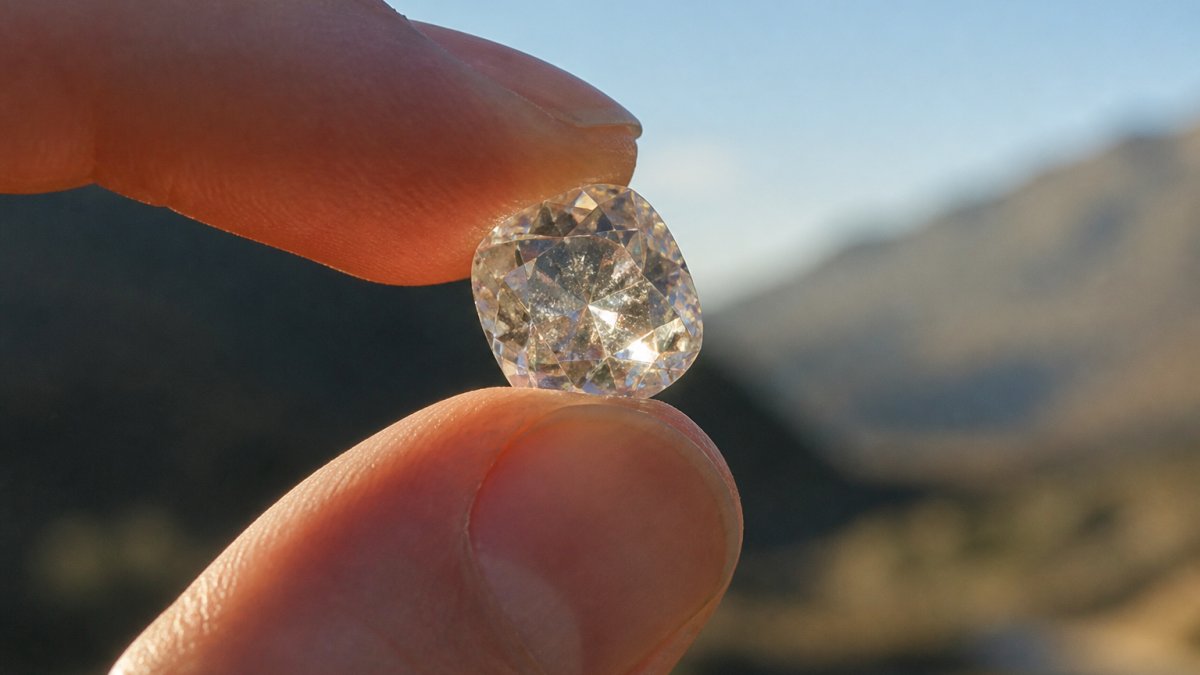
This scarcity drives natural diamond value: you're buying something genuinely rare. The formation process creates subtle variations in colour, clarity, and internal structure, which gemologists use to grade and identify natural diamonds.
That rarity and geological timeline give natural diamonds a sense of permanence, they've existed longer than human civilisation.
How Lab-Grown Diamonds Are Created
Lab-grown diamonds are created using one of two primary methods: high-pressure high-temperature (HPHT) synthesis or chemical vapour deposition (CVD).
HPHT replicates conditions deep within the Earth: a diamond seed is placed in a chamber with carbon and subjected to pressures above 50,000 atmospheres and temperatures exceeding 1,400 degrees Celsius, so carbon dissolves and recrystallises around the seed.
CVD works differently: a diamond seed sits in a chamber filled with carbon-rich gas, and energy (usually a microwave) breaks down the gas molecules so carbon atoms deposit onto the seed layer by layer. CVD typically produces larger, higher-quality stones but can take several months.
Both methods produce diamonds chemically and physically identical to natural diamonds: the same crystal lattice, hardness, and optical properties.
The difference is entirely about origin and supply: lab-grown diamonds can be produced on demand, in controlled conditions, with minimal geological waiting time.
Chemical Composition and Physical Properties
Natural diamonds and lab-grown diamonds have identical chemical composition: both are pure carbon in a cubic crystal structure, both score 10 on the Mohs hardness scale, and both have the same refractive index.
Tested side by side with standard gemological equipment, their physical properties are indistinguishable, the same density, thermal conductivity, and light performance.
Subtle differences sometimes emerge in trace elements and structural imperfections. Natural diamonds occasionally contain nitrogen that creates slight colour tints; HPHT lab-grown stones sometimes retain traces of the metal catalyst; CVD stones occasionally show strain patterns detectable only under magnification.
These differences are technical rather than practical: they don't affect how the diamond looks or performs as jewellery, only how it is identified gemologically.
The real distinction is that lab-grown diamonds are demonstrably younger, created recently, not billions of years ago. That affects how they're graded, certified, and valued.
How to Tell Lab-Grown Diamonds from Natural Diamonds
The short answer: you can't tell them apart by looking, not without specialised equipment.
This is why certification and disclosure matter. A trained gemologist with a microscope and spectroscopy equipment can identify lab-grown diamonds, looking for subtle growth patterns, trace elements, or structural markers that differ from natural stones.
The most reliable method is spectroscopy, which analyses how the diamond absorbs and reflects light at different wavelengths. Lab-grown stones sometimes show distinctive absorption patterns; HPHT diamonds occasionally show phosphorescence under ultraviolet light, and CVD diamonds sometimes show strain patterns.
Crucially, these tests require expensive equipment and trained technicians, not something a jeweller can do in-store with a loupe.
This is why disclosure is so important: a seller should tell you upfront whether a diamond is natural or lab-grown, so you don't have to guess or test it.
If a seller hasn't explicitly stated whether a diamond is natural or lab-grown, ask directly. Evasiveness is a red flag.
Lab-Grown Diamond Certification and Disclosure
Certification is where natural diamonds and lab-grown diamonds diverge most in practice. Both can be graded by independent laboratories, but the wording, tests, and disclosures differ.
What a grading report actually contains
A diamond grading report is not a valuation or a guarantee of quality, it is an independent record of a stone's measured characteristics. Expect it to state:
- The 4Cs: carat weight, cut grade, colour grade, and clarity grade
- Measurements and proportions (table percentage, depth percentage, girdle, culet)
- Polish and symmetry grades
- Fluorescence (and its colour, if present)
- Any clarity treatments or enhancements
- A unique report number, often laser-inscribed on the girdle
For a lab-grown diamond, the report must also state the growth method (HPHT or CVD) and explicitly identify the stone as laboratory-grown.
Which laboratories to look for
In the UK market, the most widely recognised grading laboratories are the Gemological Institute of America (GIA), the International Gemological Institute (IGI), and the Gem Certification & Assurance Lab (GCAL).
A report from a lesser-known or in-house laboratory carries less weight in the secondary market. For a significant stone, insist on a report from a laboratory the trade recognises.
How to verify a stone before you buy
Verification is a process, not a single check:
- Check the report number. Most reputable laboratories let you look up a report number on their website to confirm the details match the physical stone.
- Check the inscription. The report number is usually laser-inscribed on the girdle of the diamond. A jeweller should be able to show you this under magnification.
- Match the measurements. The report lists the stone's measurements in millimetres. These should match the stone you are being shown.
- Ask for the original report, not a photocopy. A photocopy can be altered. The original document, or a verified digital report from the laboratory's own portal, is what you want.
- Ask about the seller's disclosure policy. A seller should state origin in writing, on the invoice, the product page, or both. Verbal assurances are not enough.
Why this matters more for lab-grown stones
The lab-grown market has grown quickly, and not every seller has kept pace with disclosure standards, some stones are sold without third-party verification. Two stones with identical 4Cs can therefore differ in how they were produced, documented, and resold.
Price, Affordability, and Lab-Grown Diamond Resale Value
This is where many buyers focus, and where the practical differences, and the most misleading claims, become apparent.
Why lab-grown diamonds cost less
Lab-grown diamonds are significantly less expensive to produce: no geological waiting period, no mining operation, no rarity constraint.
As a broad guide, a lab-grown diamond with comparable 4Cs typically retails for a fraction of the natural stone's price.
How to compare prices like for like
For a meaningful price comparison, hold the variables constant:
- Fix the 4Cs. Choose a specific combination, for example, 1.00 carat, excellent cut, G colour, VS1 clarity, and compare only stones that match all four.
- Fix the certification. Compare a GIA-certified natural stone with a GIA-certified lab-grown stone, or IGI with IGI. Mixing laboratories introduces grading differences that distort the comparison.
- Fix the shape. A round brilliant and a princess cut of the same carat weight have different prices because of cutting yield. Compare like shape with like shape.
- Check the date. Diamond prices move. A comparison from two years ago is not a current comparison. Note the date on any price you rely on.
- Ask what is included. Setting, metal, and any additional stones in a piece affect the total price. Compare the diamond, then compare the finished piece.
Resale value: what actually happens
Resale is where the two markets diverge most sharply, and where buyers are most often misled.
Natural diamonds have a long-established secondary market. A natural diamond with a recognised grading report can typically be resold, though usually below what you paid at retail.
Lab-grown diamonds have a much thinner secondary market.
This doesn't make lab-grown diamonds a bad choice, it means treating the purchase as a consumption decision rather than an investment.
What is not predictable
It's tempting to forecast where lab-grown prices will go, but no one knows with confidence.
What you can do is buy with clear information: a certified stone, written disclosure of origin, a like-for-like price comparison, and a realistic expectation about resale.
Making Your Choice: Natural or Lab-Grown
The decision between natural diamonds and lab-grown diamonds isn't about which is objectively "better", it's about what matters to you.
Choose natural diamonds if:
- You value the geological history and rarity of a stone that took billions of years to form
- You're concerned about long-term resale value and want a diamond that holds its market value
- You prioritise the traditional meaning and symbolism associated with natural diamonds
- You're willing to pay a premium for that history and stability
Choose lab-grown diamonds if:
- You want a larger diamond or better specifications within your budget
- You prioritise the environmental profile of laboratory creation over mining
- You're less concerned about resale value and more focused on the jewellery itself
- You want to know exactly where and how your diamond was created
Both are genuine, durable, beautiful diamonds that can be certified and graded to the same standards. The difference is origin, price, and how the market values them over time.
When you're ready to choose, work with a seller who's transparent about these distinctions. If your choice involves a setting or band that needs adjustment, look for sellers offering Free Resizing so your finished piece fits perfectly without additional cost.
Choosing between natural and lab-grown diamonds is a significant decision that deserves clarity and honesty. Whether you prioritise geological rarity, budget flexibility, or environmental considerations, understanding the real differences, not the marketing narratives, is what leads to a choice you'll value. At thejewellution, we specialise in helping discerning clients navigate these choices with transparent expertise.
Frequently Asked Questions
What is the main difference between natural and lab-grown diamonds?
Natural diamonds form over billions of years deep within the Earth under extreme pressure and heat. Lab-grown diamonds are created in laboratories using high-pressure high-temperature (HPHT) or chemical vapour deposition (CVD) methods, replicating the conditions that form natural diamonds but in weeks or months. Both are chemically identical carbon crystals with the same physical properties, hardness, and durability. The difference lies in their origin and formation timeline.
Can you tell a natural diamond from a lab-grown diamond by looking at it?
No. To the naked eye, natural and lab-grown diamonds are indistinguishable. Both display the same brilliance, sparkle, and light performance. A trained gemologist using specialised laboratory testing equipment can identify the origin by examining growth patterns, trace elements, and fluorescence under ultraviolet light. This is why certification from an independent grading laboratory is essential for transparency and buyer confidence.
Do lab-grown diamonds hold their value as well as natural diamonds?
Lab-grown diamonds typically have lower resale value than natural diamonds of comparable quality. The secondary market for lab-grown diamonds is still developing, and retailers often offer lower buyback prices. Natural diamonds, particularly those with strong certifications and desirable 4Cs grades, tend to retain value more consistently. If investment potential or long-term resale value matters to you, a natural diamond is generally the better choice.
How do I know if a lab-grown diamond is certified?
Reputable lab-grown diamonds come with a grading report from recognised independent laboratories that clearly states the diamond's origin as 'laboratory-grown' or 'lab-created.' The report includes the 4Cs assessment (carat, cut, colour, clarity) and details the creation method used. Always request and review the certification before purchase to ensure transparency and authenticity. Disclosure of origin is a legal and ethical requirement in most markets.