 how-to
Find Your Ring Size: A Complete Sizing Guide
Table of Contents
- Why Getting Your Ring Size Right Matters
- How to Measure Ring Size at Home
- Measure Ring Size With a Ring You Already Own
- Ring Size Chart UK and Conversion Guide
- How Should a Ring Fit for Comfort and Security
- Factors That Affect Your Ring Size
- Sizing for Special Circumstances
- Frequently Asked Questions
Last Updated: October 11, 2026
Why Getting Your Ring Size Right Matters
Getting your ring size correct is essential before making any jewellery purchase. A ring that doesn't fit properly won't stay on your finger, may slip off, or feel uncomfortable throughout the day. The wrong size can turn an elegant piece into something you never wear.
At thejewellution, we understand that finding your ring size is the foundation of a beautiful jewellery experience. Whether you're shopping for an engagement ring, a statement piece, or a delicate band, accurate sizing ensures your jewellery becomes a trusted part of your personal style. A properly fitted ring sits comfortably at the base of your finger without rotating or pinching.
Many people guess their ring size or rely on outdated measurements. This often leads to disappointment when a carefully chosen piece arrives and doesn't fit as expected. Taking time to measure correctly now saves frustration later.
How to Measure Ring Size at Home
The most straightforward way to find your ring size involves simple materials you likely have at home. You can measure accurately without visiting a jeweller or spending money on sizing tools.
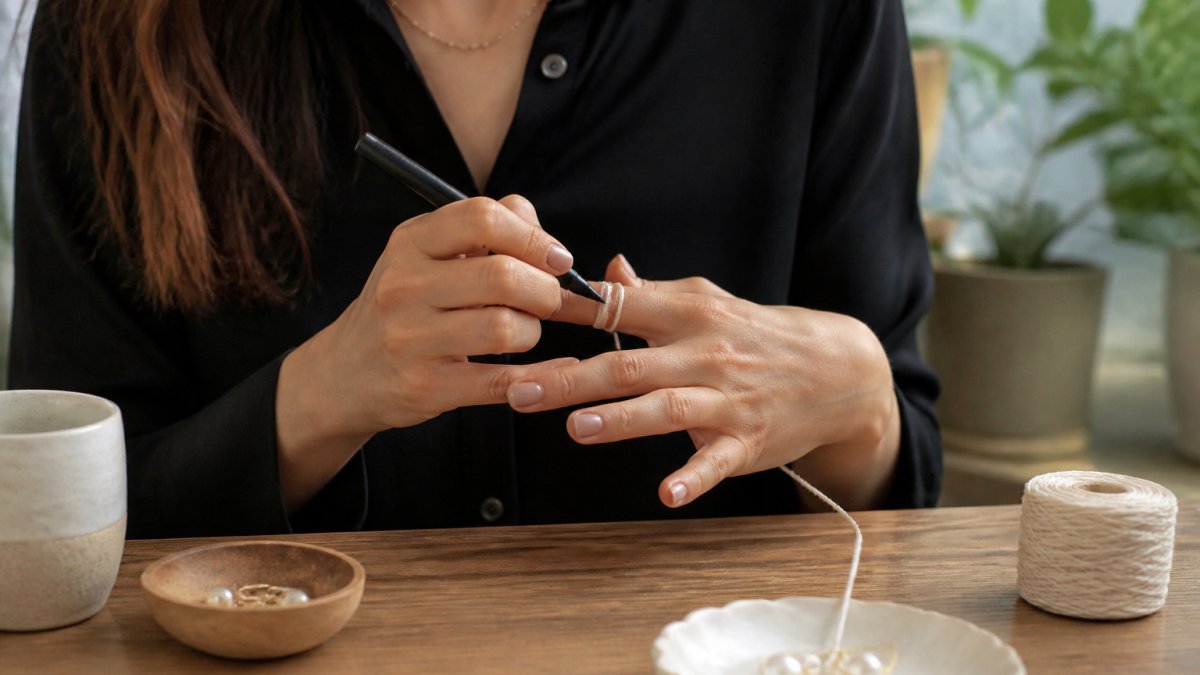
Using String or Paper
Start with a piece of string or a thin strip of paper. Wrap it snugly around the base of the finger where you'll wear the ring. The fit should be comfortable, not tight enough to cut off circulation, but not loose enough to slide around.
Mark where the string or paper overlaps with a pen. Lay the marked string flat on a ruler and measure the length in millimetres. This measurement is your finger circumference. Once you have this number, you can convert it to your ring size using a standard chart.
For accuracy, measure multiple times. Fingers can swell slightly depending on temperature, time of day, and activity level. Measure in the morning and evening to account for natural variation.
Using a Measuring Tape
A soft measuring tape designed for sewing works exceptionally well. Wrap it around the base of your finger and note the measurement in millimetres. A measuring tape gives a direct reading without needing to mark anything.
Ensure the tape sits flat against your skin without twisting. Pull it snug but not tight. Record the number where the tape meets itself.
Measure Ring Size With a Ring You Already Own
If you have a ring that fits comfortably on the finger you're measuring for, you can use it as a reference. This method eliminates guesswork about comfort and fit.
Place the ring on a ruler with the inside edge at the zero mark. Measure across the inner diameter in millimetres. This measurement directly corresponds to ring size. Write down the number and compare it to a ring size chart.
This approach works best with rings that fit well. A ring that's too tight or too loose won't give you an accurate reference point. Choose a ring you wear regularly and enjoy wearing.
Ring Size Chart UK and Conversion Guide
The UK uses letter-based ring sizes, ranging from A to Z and then AA, AB, and beyond. Each size corresponds to a specific finger circumference measured in millimetres.
| UK Size | Circumference (mm) | US Size | EU Size |
|---|---|---|---|
| A | 41 | 1 | 41 |
| B | 43 | 2 | 43 |
| C | 46 | 3 | 45 |
| D | 48 | 4 | 47 |
| E | 50 | 5 | 49 |
| F | 52 | 6 | 52 |
| G | 54 | 7 | 54 |
| H | 56 | 8 | 56 |
| I | 58 | 9 | 59 |
| J | 60 | 10 | 61 |
| K | 62 | 11 | 63 |
| L | 65 | 12 | 66 |
Once you know your finger circumference in millimetres, find the closest match in the circumference column. Your UK size appears in the same row. This table also shows the equivalent US and European sizes for reference.
Handling Measurements Between Sizes
Ring sizes fall between standard measurements. If your circumference measures 51 mm, for example, you'd fall between size E (50 mm) and size F (52 mm). This is where measurement technique and real-world fit become critical.
When your measurement lands between two sizes, take three additional readings over different times of day, morning, afternoon, and evening. Average the results. If the average is closer to the lower size, choose that; if closer to the higher size, choose that instead. This approach accounts for natural finger-size variation and reduces the risk of ordering a ring that's too loose or too tight.
If your average measurement is exactly halfway between two sizes (for example, 51 mm between E and F), consider the ring's intended use. A ring you'll wear daily benefits from a slightly looser fit to accommodate swelling; a special-occasion ring can be fitted more snugly.
Measurement Uncertainty and Practical Limits
Home measurement using string or paper typically has a margin of error of ±1-2 mm. This means if you measure 50 mm, your true circumference might be anywhere from 48-52 mm. Understanding this uncertainty helps you choose a size with confidence rather than second-guessing the result.
If your repeated measurements vary by more than 2 mm, environmental factors (temperature, hydration, time of day) are likely affecting your finger size significantly. In this case, measure during the time of day you'll most often wear the ring, and choose the size that reflects that moment. A ring sized for your evening finger will feel slightly loose in the morning, but this is preferable to a ring that becomes uncomfortably tight as the day progresses.
How Should a Ring Fit for Comfort and Security
A ring should slide over your knuckle with slight resistance but sit comfortably at the base of your finger. It shouldn't rotate freely or feel loose. At the same time, it must never pinch or restrict blood flow.
The ideal fit allows you to slide a single fingernail under the ring when it's on your finger. This tells you there's enough space for natural movement without being too loose. You should be able to wear the ring all day without discomfort.
Different ring styles require slightly different fits. A wide band may feel snug even when sized correctly, whilst a delicate thin band should feel nearly weightless. Consider the width of the ring when evaluating fit.
Factors That Affect Your Ring Size
Several conditions cause finger size to change throughout the day and across seasons. Temperature plays a significant role, cold weather causes fingers to shrivel slightly, whilst warmth makes them swell. Time of day matters too. Fingers are typically smaller in the morning and larger by evening after activity and fluid retention.
Physical activity affects ring fit. Exercise increases blood flow and can cause temporary swelling. Hormonal changes, salt intake, and hydration levels all influence how your fingers feel in a ring. If you're measuring for an important occasion, take your measurement several days in advance and average the results.
Seasonal changes are worth noting. Winter months often bring tighter-fitting fingers, whilst summer can cause slight swelling. Choose a measurement that works across all seasons rather than one taken on an unusually cold or warm day.
Sizing for Special Circumstances
Buying a Ring as a Surprise Gift
Buying a ring as a surprise gift presents a unique challenge. If you can't ask the recipient directly, gather information discreetly. Borrow a ring they wear regularly on the intended finger and measure it using the methods above.
Alternatively, ask a close friend or family member who might know their size. Many people are happy to share this information without spoiling the surprise. If all else fails, purchase from a jeweller offering resizing; this protects your investment and ensures the perfect fit arrives.
Wide-Band Rings and Comfort Adjustments
Wide-band rings require careful consideration. The wider the band, the more it can affect how the ring sits on your finger. A wide band may feel tighter than a thin one at the same size because the extra metal distributes pressure differently across the finger. When choosing a wide ring, consider going up half a size for maximum comfort.
Test this if possible: try on a thin-band ring and a wide-band ring at the same size. You'll notice the wide band feels noticeably snugger. This is normal and expected, not a sign of incorrect sizing.
Resizing Limits and Material Considerations
Not every ring can be resized, and understanding these limits before purchase prevents disappointment. The material, design, and construction of the ring determine whether adjustment is possible.
Gold and Silver Rings: Traditional precious-metal rings in 9-carat, 14-carat, 18-carat gold or sterling silver are almost always resizable. A jeweller can cut the band, add or remove metal, and re-solder the joint.
Rings with Gemstones: Rings featuring diamonds or gemstones set into the band can often be resized, but with limitations. If the stone is set very close to where the jeweller must cut the band, resizing may not be possible without risking the setting. Solitaire rings and those with stones set away from the cutting point are usually safe to resize. Always consult a jeweller before assuming a gemstone ring can be adjusted.
Platinum Rings: Platinum is denser and more difficult to work with than gold or silver, but it is resizable. Resizing platinum typically costs more and takes longer because the metal requires specialist equipment and expertise.
Titanium and Tungsten: These modern metals are extremely hard and cannot be resized by traditional methods. If you purchase a titanium or tungsten ring, sizing must be correct at the point of purchase. Always confirm the exact size before ordering.
Rings with Intricate Design or Engraving: Rings featuring detailed patterns, filigree, or engraving throughout the band may be difficult or impossible to resize without damaging the design. A jeweller can assess whether the design allows for resizing, but ornate rings often cannot be adjusted.
Eternity Rings and Full-Band Stone Settings: Rings with stones set all the way around the band cannot be resized because there is no plain metal section where a jeweller can safely cut and rejoin. These rings must be ordered in the correct size from the start.
Frequently Asked Questions
How do I measure my ring size accurately at home?
Wrap a piece of string, paper strip, or measuring tape around the base of your finger where the ring will sit. Make sure it's snug but not tight, you should be able to slide a fingertip underneath. Mark where the string overlaps, then measure that length in millimetres. Divide by 3.14 to get the diameter, then use a UK ring size chart to convert your measurement. For best results, measure multiple times and take the average.
Can I find my ring size using a ring I already own?
Yes. Place an existing ring that fits comfortably on a flat surface and measure the inner diameter across the widest part using a ruler in millimetres. Then refer to a UK ring size chart to match that diameter to your size. This method works well, but ensure the ring you're measuring actually fits the finger you intend to wear the new ring on, as finger sizes can vary slightly.
Does ring size change throughout the day?
Yes, finger size can fluctuate due to temperature, activity level, time of day, and even diet. Fingers tend to swell slightly in warm weather and during or after exercise, and may be smaller in the morning. For the most accurate sizing, measure your finger in the afternoon when it's at a relatively neutral state, and avoid measuring immediately after exercise or in very hot conditions.
What should I do if my measurement falls between two ring sizes?
If you're between sizes, consider the ring's width. Wider bands may feel tighter, so you might prefer the larger size for comfort. For narrow bands, the smaller size often works well. You can also look into whether resizing is available after purchase to ensure a perfect fit once you receive your piece.